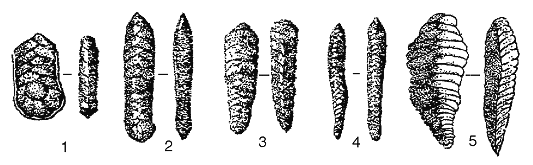
Fig. 104-1. Five species of Spiroplecta described by Grzybowski (1898, 1901) here regarded as synonymous with S. spectabilis (redrawn from the type figures). 1. Spiroplecta brevis Grzybowski, 1898. 2. Spiroplecta spectabilis Grzybowski, 1898. Spiroplecta costidorsata Grzybowski, 1898. 4. Spiroplecta foliacea Grzybowski, 1898. 5. Spiroplecta clotho Grzybowski, 1901 ORIGINAL DESIGNATION: Spiroplecta spectabilis Grzybowski, 1898. TYPE REFERENCE: Grzybowski, J., 1898, Otwornice pokładow naftonośnych okolicy Krosna. Rozprawy Wydziału Matematyczno-Przyrodniczego, Akademia Umiejętności w Krakowie, serya 2, vol. 33, p. 293, pl. 12, fig. 12. See also: Kaminski, M.A. 1984. Shape variation in Spiroplectammina spectabilis (Grzybowski). Acta Paleontologica Polonica, 29, 29-49. TYPE SPECIMEN: Not originally designated. Numerous specimens from Grzybowski's samples are deposited in the micropaleontological collections of the Jagiellonian University, Kraków. Syntypes of Spiroplecta spectabilis preserved in the Grzybowski Collection of 1898 are registered as UJ-132-P, 1/82a. This slide contains three specimens, one of which corresponds to the type figure. Kaminski & Geroch (1993) designated this specimen the lectotype. An additional syntype of S. spectabilis labelled "Potok" is registered in slide UJ-132-P, 1/82b. Syntypes of Spiroplecta brevis are registered as UJ-132-P, 1/83a-e. Syntypes of Spiroplecta foliacea are registered as UJ-132-P, 1/84a. The type specimen of Spiroplecta costidorsata is registered as UJ-132-P, 1/85. TYPE LEVEL: Paleogene, Silesian Unit of the Polish Carpathians. TYPE LOCALITY: Not originally designated. Grzybowski reported Spiroplecta spectabilis from three exploration wells drilled in the vicinity of Krosno Poland. The lectotype is from the Potok H-33 well, 170 m. Syntypes of Spiroplecta brevis are from the Potok H-33 well, 170 m, 210 m, 227 m, and 15 m. Spiroplecta foliacea were described from an additional six wells. Syntypes in the collection are from the Potok H-40 well, 24 m, and from an outcrop sample labelled "Krościenko, red clay". The type specimen of Spiroplecta costidorsata is from the Potok H-26 well, 95 m. DIAGNOSTIC FEATURES: Test free, initially planispiral, later biserial. In megalospheric forms, the planispiral portion consists of 4-7 chambers, and may be wider than the subsequent biserial portion. The planispiral portion of microspheric forms is minute in comparison, and may also be wider than the biserial part. Chambers in the biserial part are low and numerous. As many as 36 biserial chambers have been observed in microspheric individuals. In both generations, the biserial part is rhomboidal in cross-section and has nearly parallel sides, though in microspheric forms it normally increases in breadth initially and may decrease in breadth distally. Sutures are normally flush or depressed slightly. In the biserial part, sutures and inclined approximately 60° to the long axis of the test. Peripheral margin is acute, and may be dentate or weakly keeled. Wall is imperforate, finely agglutinated with a smooth surface. Forms living on pelagic substrates may agglutinate coccolith debris. Aperture is a narrow interiomarginal slit. SIZE: Mean length varies from 0.35 to 1.25 mm. The lectotype of S. spectabilis is 0.20 mm x 0.55 mm. SYNONYMS: Spiroplecta brevis Grzybowski. Grzybowski, J., 1898, Rozpr. Wydz. Matemat.-Przyr., Akad. Umiej. Krakow, ser. 2, 33, p. 293, pl. 12, fig. 13. Spiroplecta foliacea Grzybowski. Grzybowski, J., 1898, Rozpr. Wydz. Matemat.-Przyr., Akad. Umiej. Krakow, ser. 2, 33, p. 293, pl. 12, fig. 12. Spiroplecta costidorsata Grzybowski. Grzybowski, J., 1898, Rozpr. Wydz. Matemat.-Przyr., Akad. Umiej. Krakow, ser. 2, 33, p. 294, pl. 12, fig. 11. Spiroplecta clotho Grzybowski. Grzybowski, J., 1801, Rozpr. Wydz. Matemat.-Przyr., Akad. Umiej. Krakow, ser. 2, 41, p. 283, pl. 7, fig. 18. Spiroplectoides clotho (Grzybowski). Cushman, J.A., & Jarvis, P.W., 1928, Contr. Cush. Lab. Foram. Res. 4, p. 101, pl. 14, fig. 13. ?Spiroplectoides eocenica Cushman & Barksdale. Cushman, J.A. & Barksdale, J.D., 1930, Contr. Stanford Univ. Geol. Dept. 1, p. 66, pl. 12, fig. 5a,b. Spiroplectoides californica Cushman & Campbell. Cushman, J.A., & Campbell, A.S., 1934, Contr. Cush. Lab. Foram. Res. 10, p. 70, pl. 9, fig. 13-14. Spiroplectammina mexiaensis Lalicker. Lalicker, C.G., 1935. Contr. Cush. Lab. Foram. Res. 11, p. 43, pl. 6, fig. 5-6. Spiroplectoides directa Cushman & Siegfus. Cushman, J.A., & Siegfus, S.S., 1939. Contr. Cush. Lab. Foram. Res. 15, p. 26, pl. 6, fig. 7-8. Spiroplectammina grzybowskii Frizzell. Frizzell, D.L., 1943. J. Paleontol. 17, p. 339, pl. 55, fig. 12a-13. Spiroplectammina perplexa Israelsky. Israelsky, M.C., 1951. U.S. Geol. Surv. Prof. Paper 240-A. p. 12, pl. 3, fig. 9-14. Spiroplectammina brunswickensis Todd & Kniker. Todd, R., & Kniker, H.T., 1952. Cush. Found. Foram. Res. Spec. Publ. 1, p. 6, pl. 1, fig. 16. OBSERVED OCCURRENCES: Spiroplectammina spectabilis is one of the best known and widely distributed Paleogene species of deep-water agglutinated foraminifera. It was first described from the Paleogene of the Carpathian flysch (Grzybowski, 1898), and has been subsequently found in the Caucasus (Glaessner, 1937; Subbotina, 1950), Caribbean (Cushman & Jarvis, 1928), Tunisia (Aubert & Berggren, 1976), along the Pacific margin of North and South America (Cushman & Campbell, 1934; Todd & Kniker, 1952), in the Northwest Pacific (Serova, 1987; Kaiho, 1992), South Pacific and Papua New Guinea (Webb, 1975; Haig, 1982; Milner, 1997), New Zealand (Kaiho et al., 1996), South Atlantic (Widmark, 1997), and throughout the North Atlantic and North Sea provinces. In its type area, the first occurrence of this species marks the base of the Late Paleocene Spiroplectammina spectabilis Zone of Geroch & Nowak (1984). However, this event in the Polish Carpathians may reflect the immigration of the species, since it undoubtedly occurs in the Maastrichtian in Trinidad (Kaminski et al., 1988; Beckmann, 1994), in northeast Venezuela (Galea-Alvarez, 1985), on Sakhalin Island (Serova, 1987), and on Hokkaido (Kaiho, 1992). It is found in the Lower Paleocene of other areas of the Carpathians as well as in the Atlantic. Martin (1964) reported it as Spiroplectammina perplexa from the Lower Danian of the Moreno Formation in California. In the Romanian Eastern Carpathians, Ion (1995) recorded its FO in the G. eugubina Zone in the Lepsa Beds, and noted reports of it in the uppermost Maastrichtian of the Hangu Beds. Based on these occurrences, Ion (1995) argued for restricting the S. spectabilis Zone in the Romanian Carpathians to the interval between the LO of Rzehakina inclusa and the FO of Saccamminoides carpathicus. 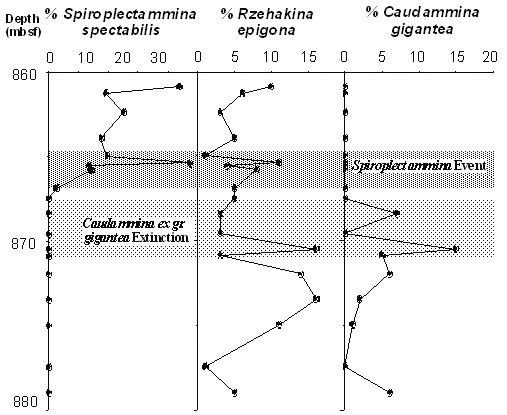 Fig. 104-2. Abundance variations of common DWAF across the K/T boundary interval at ODP Site 959 off the Ivory Coast. The early Danian acme in Spiroplectammina spectabilis has now been observed at several localities in the Atlantic and western Tethys, after Kuhnt et al. (1998) In the Zumaya section of northern Spain, its first occurrence is near the base of Zone P4. In the northern areas of the North Atlantic, S. spectabilis can be abundant in sediments of Late Paleocene age. It displays a distinctive abundance maximum in the lower part of Upper Paleocene in the western Barents Sea. Its last common occurrence occurs near the base of the uppermost Paleocene tuff horizon in the North Sea and Barents Sea, and near the Paleocene/Eocene boundary along the Labrador Margin. Another acme in S. spectabilis has been found in the Contessa Road section near Gubbio within Zone NP9, just beneath the Paleocene/Eocene boundary carbon isotope excursion (Galeotti et al., 2000). The last occurrence of S. spectablis is generally within the Middle Eocene along the North Atlantic margins. However, at paleobathymetrically deeper localities it ranges into Upper Eocene. At ODP Site 647 in the Labrador Sea its LO coincides with the Eocene/Oligocene boundary as determined by nannofossils and magnetostratigraphy. Verdenius & Van Hinte (1983) used this species to determine the top of the Eocene in DSDP sites in the Norwegian-Greenland Sea. In a study of a paleobathymetric transect in the Central North Sea, Jones (1988) reported it as common in upper slope and basin plain assemblages but less common in the middle slope facies. In the Polish Carpathians its LO coincides with the base of the uppermost Eocene "Globigerina Marls". KNOWN STRATIGRAPHIC RANGE: Maastrichtian to latest Eocene. BATHYMETRY: Bathyal to abyssal. REMARKS: Spiroplectammina spectabilis may be one of the most widely recognized Paleogene species, since it figures prominently in a number of zonal schemes. This species may be considered as a plexus of forms that differ in length and thickness, with significant differences between end members (Kaminski, 1984). This variability has no doubt contributed to the multiplicity of available junior synonyms. The concept of Spiroplectammina spectabilis adopted here consists of no fewer than 11 validly described species. 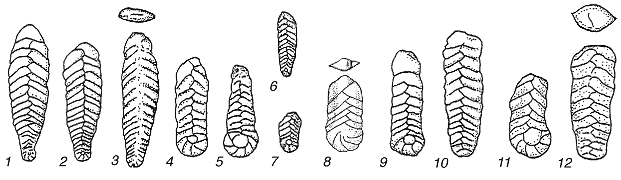 Fig. 104-3. Specimens of S. spectabilis from localities in the Americas illustrated by Cushman (1927, 1934), Cushman & Campbell (1934) and Cushman & Siegfus (1939), redrawn from Cushman's illustrations. 1-5. Specimens reported as "Spiroplectoides clotho". Specimen #3 is from the Velasco Shale of Mexico, others are from Trinidad. 6-7. Specimens reported as "Spiroplectoides spectabilis" by Cushman (1934). 8. Specimen reported as "Spiroplectoides eocenica" by Cushman & Barksdale (1930). 9-10. Specimens reported as "Spiroplectoides californica" by Cushman & Campbell (1934). 11-12. Specimens reported as "Spiroplectoides directa" by Cushman & Siegfus (1939) Spiroplectoides directa was described by Cushman & Siegfus (1939) from the Middle to Upper Eocene Kreyenhagen Shale at Garza Creek, California. The species was described as having a thin, perforate, calcareous wall and a terminal aperture. The holotype (CC 25445) is apparently silicified with an agglutinated test, and the specimen is broken at its apertural end. This gives it the appearance of having a terminal aperture. The species was again reported by Cushman & Siegfus (1942) from the Kreyenhagen Shale type locality. Cushman & Renz (1948) later used this name for specimens from the Middle Eocene Navet Formation of Trinidad. 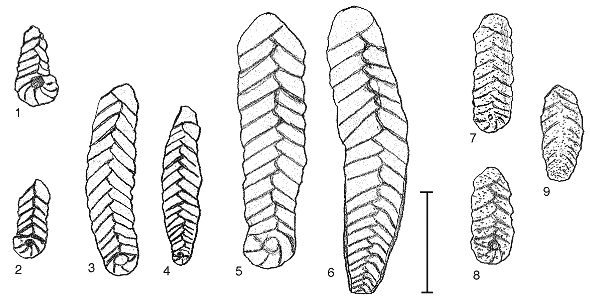 Text-fig. 104-4. Type specimens of four species from the Cushman Collection considered here to be junior synonyms of S. spectabilis (all camera lucida drawings by MAK, scale bar = 0.5 mm). 1-2. Spiroplectammina perplexa Israelsky, Lodo Formation, Tumey Hills, Fresno Co. CA. 1. Holotype (USNM 560501); 2. Paratype (USNM 560502). 3-4. Spiroplectammina brunswickensis Todd & Kniicker, middle Agua Fresca Formation, Brunswick Peninsula, Magallanes Province, Chile. 3. Holotype (CC 64279); 4. Paratype (CC 64280); 5-6. Spiroplectammina grzybowskii Frizzell, Mel Paso Shale, I.P. Co well 1755, 1960', paratypes (CC 39551, CC 33552); 7-9. Spiroplectammina mexiaensis Lalicker, Mexia Point Formation, "2 mi N & SW of the center of Mexia, Limestone Co., TX", 7. Holotype (CC 21924); 8-9. Paratypes (CC 21925; USNM 371544) The generic affiliation of S. spectabilis is still unsettled due to the uncertain status of the genus Bolivinopsis. According to the current generic definitions of Loeblich & Tappan (1987), S. spectabilis clearly belongs in the genus Bolivinopsis. The type species of Spiroplectammina, (Textularia agglutinans var. biformis Parker & Jones, 1865), has organic cement, a rounded periphery, and an initial spiral part that is of lesser width than the biserial portion of the test. We have previously regarded the genus Bolivinopsis as nomen dubium following the suggestion of Frizzell (1943) because of the lack of preserved specimens of its type species, Bolivinopsis capitata Yakovlev, 1891. This species was reported from the Upper Cretaceous of Russia by Yakovlev, and the nature of its cement is unknown. Macfadyen (1933) considered B. capitata to be a junior synonym of Spiroplecta rosula Eherenberg, a species with an imperforate test and calcareous cement. Kisselman (1964) has pointed out that even in the type region of B. capitata, the designation "B. rosula" is used for these forms. Loeblich & Tappan (1987) remarked that "Cenozoic species previously assigned to Bolivinopsis are probably not congeneric", and listed the genus as restricted to the Late Cretaceous. They do not mention the composition of the cement, and Bolivinopsis is distinguished from Spiroplectammina in being more elongate and compressed, and in having a smoothly finished wall. Although we agree in principle with the generic scheme for the spiroplectamminids adopted by Loeblich & Tappan, in our opinion, the genus Bolivinopsis needs to be validated by examining the nature of its cement and designating a lectotype for its type species. Until this is done, we retain the Cenozoic forms in Spiroplectammina. ILLUSTRATIONS: Plate 104 - Spiroplectammina spectabilis (Grzybowski) emend. Kaminski Type specimens of S. spectabilis and Grzybowski's junior synonyms. Fig. 1a-c. "Spiroplecta spectabilis Grzybowski" (Grzybowski Collection; UJ-132-P 1/82a) Potok H-33, 170 m, probably the plesiotype of Grzybowski (1898, pl. 12, fig. 12). 1a,b- reflected light, 1c- cross-polarised light, Lectotype, Length = 1.0 mm; Fig. 2a,b. "Spiroplecta spectabilis Grzybowski" (Grzybowski Collection; UJ-132-P 1/82b), "Potok" exact locality unknown, 2a,b- reflected light, length = 1.15 mm; Fig. 3a-c. "Spiroplecta brevis Grzybowski" (Grzybowski Collection; UJ-132-P 1/83a) "Potok" exact locality unknown, plesiotype of Grzybowski (1898, pl. 12, fig. 13), 4a,b- reflected light, 4c- cross-polarised light, length = 0.72 mm; Fig. 4a,b. "Spiroplecta foliacea Grzybowski" (Grzybowski Collection; UJ-132-P 1/84a) Potok H-40, 24 m, 4a- reflected light, 4b- cross-polarised light, length = 0.74 mm; Fig. 5a-c. "Spiroplecta clotho Grzybowski" (UJ-133-P 2/100a) Bartne 14 (80), plesiotype of Grzybowski (1901, pl. 7, fig. 18), 5a,b- reflected light, 5c- cross-polarised light, length = 0.84 mm; Fig. 6a,b. "Spiroplecta costidorsata Grzybowski" (UJ-132-P 1/85b) Potok H-26, 96 m, probably the plesiotype of Grzybowski (1898, pl. 12, fig. 11), 3a- cross-polarised light, 3b- reflected light, L= 0.78 mm. All specimens from the Grzybowski Collection, courtesy of S. Geroch (light microscope photos). 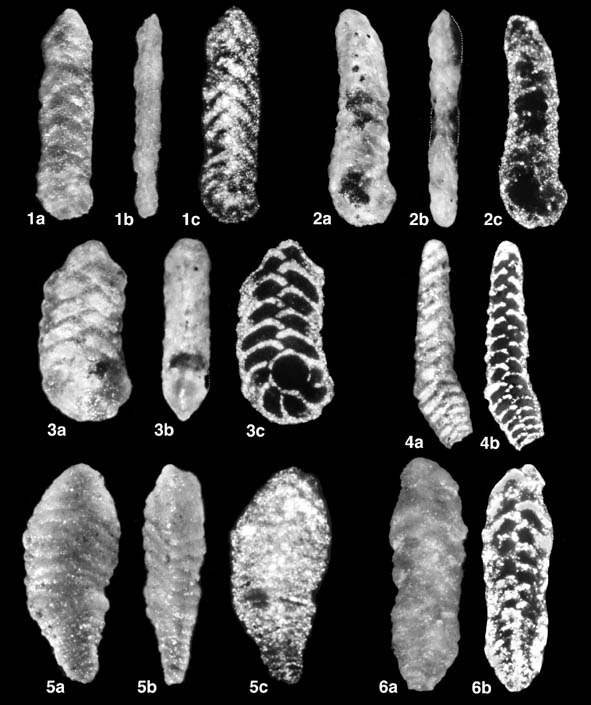
|